Andrew Theiss - Educator, Burner, Geodesic Dreamer, Rubicon Project and Accidental Philosopher.

Andrew Theiss is a Computer Science teacher at Harvard-Westlake School in Los Angeles. Before teaching, he spent years in the tech industry as a Platform and UI Engineer at Rubicon Project and as an Associate Software Engineer at E*TRADE Financial, where he led the HTML5 initiative and built their cross-platform tablet application. He studied Computer Science at UC Davis. Outside of the classroom, Andrew is a passionate self taught chocolatier, a devoted annual attendee of Burning Man for which he built a 21 foot geodesic dome, and someone who has thought deeply about creativity, consciousness, and what it means to live a meaningful life. He spoke to me over Zoom from his home in Los Angeles.
How did you first get into technology growing up? Were there specific projects or moments that made you realize that was where your interest was?
My dad is a physicist and my stepdad is an aerospace engineer, so there was a lot of involvement from them in my upbringing. They put locks on my internet usage so every night when the internet would go out I would just sit there for two hours thinking, well, I might as well try to figure out a way around this. So I really started messing around with the computer to get around all the firewalls they put on. I didn't even realize until a couple of years down the line that it was the seed that planted my interest in technology as a whole, especially in computer security and programming. It forced me to have directed my focus towards solving a problem on a computer and it just so happened that task was getting me back online.
Did that curiosity eventually lead into coding more seriously?
I went into mechanical and aerospace engineering in college because my parents really pushed me in that direction. I had what felt like the best internship possible at a machine shop called Mori Seiki Machining, a Japanese company that was going to fly me to Japan. I basically pushed their machines to the limit. They machined things on the micron scale, which is incredibly tiny, and needed temperature-controlled rooms just to operate. That was a lot of fun. But then I also picked up a side programming job for some pocket cash, and I loved it so much that every day I was genuinely excited to show up. Also, now that I think about it, something that probably also helped was that the reality was UC Davis summers are supremely boring, truly the most boring thing you'll ever experience. It was out of that boredom that I began coding just for fun. Then one day I caught myself and thought, oh wait, I'm coding for fun. Uh-oh, I should probably be doing this. So I switched to computer science and I've been doing it ever since.
You mentioned boredom as a catalyst for creativity. What do you think about kids today who have constant access to social media and dopamine hits and never really get the chance to actually be bored?
Yeah I mean, as soon as you set the question it became so obvious, the overabundance of stimulation is so readily available that I can't imagine people being that bored anymore. There are dopamine hits even when you don't try to seek them out now. Even today I can get caught scrolling for hours and just be like, wait, what am I doing? And then I'll just uninstall the app. I don't think it's unreasonable to say people genuinely can't get that bored anymore. The circumstances needed to arrive at real boredom are just much more rare because of the availability of all the stimulation that surrounds us.
I've been reading about quantum computing lately, especially how chips are getting down to the atomic level and there could theoretically be a cap on how powerful classical computers can get. What do you think about where quantum computing is headed?
There are so many opinions on this. IBM has put out a whole series on quantum computing, and their formative statement is basically that it's going to replace all computing but it's important to remember that's their super biased approach. Some people think classical computing isn't going anywhere.
The technical challenge with quantum computers is that the quantum state gets lost after a certain amount of time which is a problem called decoherence. The spins on the orbitals that hold the quantum state just don't last. Even if you can hold a state for a thousandth of a second, you can do trillions of operations in that window. So the whole challenge is keeping it stable and coherent. Meanwhile, classical computing still has the heat problem. There's a little quartz clock inside every computer, and if you put more electricity into it, it'll go twice as fast. The problem is the heat produced will actually break the computer. So every computer now is basically a giant heat sink sitting on top of the chip just to get rid of that heat.
There's room for advancement in both. Quantum is so new and fresh that it's much easier to make new strides right now. There are three or four completely different physical strategies people are developing to make quantum states representable in a machine. Some are using magnetism, some use orbitals since the nature of it is that it's so early there really isn't a single approach that has matured yet. Whereas with classical computing, even if you have a brilliant new idea, the whole world runs on classical infrastructure and it takes forever to get anything adopted at a meaningful scale. There's actually a gallium-based approach that has better thermal characteristics than silicon and could make for meaningfully better classical computers, but it moves slowly.
That said, every computer scientist in industry seems to agree: quantum computing is going to be added to our current computing base. It is useful. It is going to happen. It is inevitable. All classical security systems are already being updated to be quantum resistant. The US government has given serious talks about becoming quantum ready, because security as we know it will eventually be broken. Any encrypted message being sent on the internet right now could theoretically be cracked by a powerful enough quantum computer. Countries are actually saving encrypted data from today's internet so that as soon as quantum computers become capable enough, they can crack the keys and read all that old mail.
Where I think quantum will have its most real near-term impact is in their modeling capabilities. Right now, if you want to model how a ball drops or how a galaxy forms, classical computers can't do it beyond certain constraints. Quantum is going to enable modeling things on the submolecular or molecular scale instead of just on the macro level which will make for better predictions and ultimately better science.
Since we're on security, what does quantum computing mean for Bitcoin? The whole system is based on a series of math equations that are hard to crack. If you can suddenly decrypt those really fast, doesn't that change everything?
Yes definitely the SHA-256 secure hash algorithm that Bitcoin uses today will eventually be crackable by a sufficiently powerful quantum computer, which would make Bitcoin as it currently functions useless. However, the Bitcoin codebase is constantly evolving. There are over 20,000+ commits that have gone into that codebase, including some from just yesterday. These developers know quantum is coming, and they have already been making changes for the last two to four years to prepare. There's a projected window of at least 10 to 15 years before quantum computers get anywhere near that capable. You can be sure the whole network will update before that moment arrives. It's essentially one of those forced computer updates which is a little annoying, but necessary, except this one is for all of Bitcoin.
Where do you see crypto going more broadly? I first got into it around fifth grade just from the idea of scarcity and being able to turn money into more money, but I'm not sure I fully understand all the real applications. What actually interests you about it?
I'm pretty heavily invested in crypto, both financially and in terms of my free time. I program nothing but crypto contracts right now. But the thing I keep coming back to is decentralization. Let me give you an example of why it matters so much.
A year back my phone got hacked by a hacker pretending to be me tricking tech support to give them access. Apple has told me they will not recover my account even though I know they have the ability to do it. So I've lost all of my iCloud photos, all of my app purchases, basically everything. That's a case where a corporation has rules that are completely screwing over an individual, and there's nothing that person can do about it.
Crypto has the power to change that dynamic. There's no on or off switch owned by a corporation or government. Computer code makes the decisions, and that code is fully public, if you can read it, you can see exactly how the system behaves. If you lose your account or password in crypto, you alone are responsible. No individual has the ability to just flip a switch and shut it down. Countries have made it illegal. Corporations have tried to own it by acquiring massive computing power. They've all failed or come up short. I think the real power of crypto is that it will eventually equalize the playing field between huge powers and individual people. It's data owned by the people, for the people.
Can you explain what mining actually is for someone who sort of understands it but not fully?
The people who created Bitcoin were asking: how do we make this so secure that no one can change it or attack it? Their answer was a mathematical algorithm that is extremely difficult to compute. If everyone on earth tries to solve this problem simultaneously, it's so hard that out of every 100 million people all trying at once, only one will solve it every ten minutes or so.
That means if someone wants to attack the Bitcoin network, they also have to solve this problem first. So, how hard is it for an attacker? They would need a computer so powerful that it could solve two of these problems one after another faster than every other person on the entire network combined. The security model is: let's make this so hard that any attacker needs more computing power than everyone currently playing the game. A miner is simply someone playing the game, running their computer, trying to solve that really hard math problem, and earning a portion of Bitcoin when they succeed.
Ethereum works slightly differently. Instead of solving a math problem, you share your computer with the network and allow people to run programs and store data on it. A program run on Ethereum actually runs across about 100,000 computers globally and gets saved on the same amount of computers globally. So if you want to save something permanently on Ethereum, there's essentially no way to take it offline because it exists in so many different places across the fabric of the internet. That decentralization, individual people with their computers all on, is the real power behind these systems and the reason no government or corporation can shut them down.
Can you take me through your path from college to where you are now, the beautiful and the ugly?
I was a pretty immature and underdeveloped person psychologically for a long time. My desires were basically just about having fun and repressing a lot of insecurities. Through college I was pretty much partying the whole time. I definitely abused alcohol for a lot of my time in college. I didn't take real interest in self development or care about what I was learning. I had no productive side projects. None whatsoever.
Then there were a couple of moments in my life that were really pivotal, moments that changed who I was inside and made me want to become the best version of myself.
One of them was a literal second chance at life. I woke up in a hospital because I had taken some random pill from a stranger at a club. They resuscitated me. The address on my ID was my mom's, so six months later she received all my medical records showing everything that had been in my system. And here's the thing, when a really huge life event happens, you don't immediately learn from it. It takes time to reflect on the fact that you almost died. It makes you rethink life and reality itself. Then gradually you start feeling genuine gratitude just for being alive. Out of that gratitude everything else came. One step after another, becoming grateful for the ability to learn, to create things, to give things to others and make a difference in the world. That's actually where the chocolate came in later. It took two or three years for this to happen subconsciously and another two or three years for it to really become conscious.
So in college I was going through school, not getting great grades, but I did love coding and I was doing it for fun but I was just spending that money on partying and raving. Then I got my job at E*TRADE and surprisingly, the people there were partying even harder than I had been. The abuse really peaked there. But then I moved to LA and I genuinely learned to grow up.
I should also mention, my dad passed away from a heart attack midway through COVID. He had always been critical of me not going back to pure tech, where I could make two or three times as much. He always told me: “Get a house, do better.” It took a lot of self awareness to be able to say to him when I eventually moved into education that: I'm genuinely happy working with people as the core reason for my job rather than building machines. I love building machines, I love coding, but it took real self understanding to choose teaching instead and own that decision most importantly, to myself.
In class you have mentioned Burning Man a few times. What has Burning Man actually given you, and how did it shape your values and who you are today? What does it mean to be a “Burner”?
Yeah, surprisingly Burning Man is where I found the values that I think make me fit in so well at Harvard Westlake, even though administration definitely doesn't love me putting those two things in the same sentence.
The beautiful thing about Burning Man is that every single idea you've ever had, someone there has already created. It's a buffet of art where every wild curiosity, every question, maybe I should make this, that'd be cool if someone did this, it's already there. Someone made it. And all of your what ifs become real possibilities and it makes you adopt the attitude that “if they can do it so can I”. You can walk up to any art piece or structure and the artist is standing right there. You say, “dude, this is awesome”' and they say, “yeah thanks man, it took me five years and $200,000, and we're burning it down tomorrow feel free to check it out before it's gone.” It forces appreciation for what's in front of you, in the moment. That experience, alongside my self reflection, pushed me toward creative outlets I'd never considered before. I also loved the attitude that I observed there to do things truly for yourself which I had a realization that I didn’t really do before I was a burner. It changed me in the absolute best way imaginable.
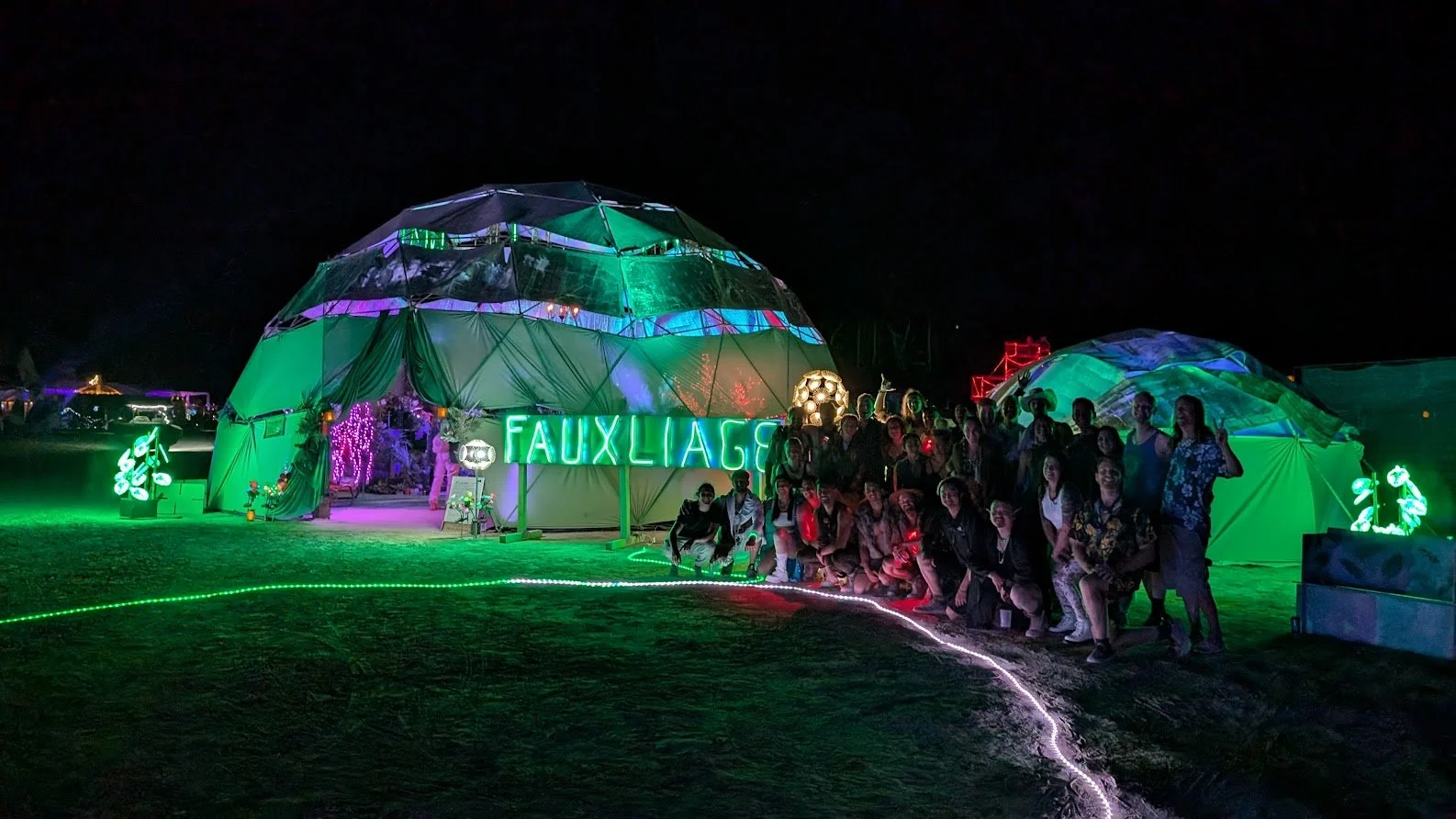
I told myself I wasn't going back unless I built the biggest structure I possibly could. So I went to a steel shop, spent about $10,000 on steel, and built a 21 foot geodesic dome. The next year I went back and built one of the fifth largest domes at Burning Man.

Here's how I'd compare them: HW is excellence first, joy second. Get the A's, do the things, and hopefully you enjoy some of it too. Burning Man is joy first, excellence second, everyone there is doing extraordinary things because they're genuinely happy, because it brings them real joy. They really are two sides of the same coin. I actually deeply appreciate HW's values because I've seen the same pursuit of excellence from a completely different angle. It’s cliche to say but perspective really is the key.
Chocolate and computer science seem like they'd never go together. How did chocolate come into your life, and were there any unexpected parallels between the two?
Chocolate definitely came out of the pandemic. I had some cacao beans in the house because a friend wanted them for his trail mix company. But the real origin was something deeper. I wanted to be able to give people close to me something without it feeling transactional. Everything in life becomes a transaction now. As soon as you give someone something, they're already saying “Ah, let me pay you back, I'll get you next time.” I just wanted to give someone something and have them accept it and move on. No reciprocation needed.
Chocolate turned out to be the perfect vehicle for that. When it was terrible and it was definitely complete garbage for a long time people would politely eat it and say thank you. But when it got good, people would eat the bar, say thank you, and just go on with their day without feeling like they owed me anything. In a transactional world, that kind of unconditional giving is rare. Burning Man teaches you the same thing: people give you something, you accept it, you move on. You don't owe them anything.


Now there's a lot of pressure from people around me to industrialize it, turn it into a business, scale it up, do the social media thing, all of that. And honestly, I'm hesitant. Selling it is the exact opposite of the dream from which it came. I'm currently wrestling with whether I'll be able to hold on to the joy it originally brought me if I go the mega corp route. But that door is now open and I'm trying to figure out how to walk through it without losing what made it worth doing in the first place.
What is one question you think more people should be asking right now - about technology, creativity, or anything else?
Who am I when I step away from my thoughts?
Have you ever just sat and listened to your own thoughts without immediately reacting to them? In adolescence especially, it's so easy to have a thought and immediately act on it like a kid in class who's clearly thinking about something completely unrelated and it just flies out of their mouth the second it enters their head. But what if you just let a thought exist without engaging with it? What if you just watched it go by? I think if you sit and listen to your own thoughts over and over, you learn so much about what values you've been holding onto without even knowing, patterns that you just automatically act out every day. I think the best creativity comes from identifying what you actually care about most: Know thyself, some old guy said that, and I think he was right. Once you figure out who you are and what you genuinely value, passion follows right behind it. There's no question about where the creativity comes from.
The times I'm most lacking in creativity and passion are the times I get so distracted by social media, the brain rot. I lose track of my own values entirely. I stop listening to myself. And then it takes a lot of stepping back and going inward again to get back to that place. Meditation, silence, whatever you want to call it. My favorite piece of advice from the Buddha is actually: please don't listen to anything I say. Don't believe me at all. Just try it yourself, and you'll find out. And I think that's the right approach too. A sincere attempt to sit with your own thoughts is worth any time you can spare for it.
I recently watched an interesting video on the world’s obsession with productivity and its adverse effects it has in pursuit of a benefit. What's your take on the obsession with productivity, 100 hour work weeks, always optimizing, grinding harder and harder?
Here's a thought experiment. Imagine you're the best trench digger for irrigation in the world. The most efficient, most optimized, every bit of effort you have goes fully into it. Then halfway through your life, someone comes out with a machine that does it all automatically. What was the point of grinding so hard?
I lived in that rat race. I was coding competitively in tech, trying to get the mobile app out the door first with full features, racing everyone else. Ten years ago that was the game, everyone wanted a mobile app, and you had to beat everyone else to it. Now a high schooler who understands AI can do it in one sitting. So I worked 100 hour weeks for years to do something that now takes an afternoon.
I'm not saying don't work hard, there is a nuance. But don't worship productivity as the goal itself. I think if you focus on yourself and find the joy from within first, you'll naturally be the best version of yourself and produce incredible things out of that state. Find happiness and most importantly a genuine spark, and you'll start producing from that. Don't grind and hope happiness shows up at the end, it usually doesn't. Do what you care about, and through that care, you'll be the most valuable version of yourself to yourself.
Go support Andrew’s chocolate! - Chocolate Party